The Serbian festival announced that its NFT VIP Gold and NFT VIP Infinite Experience passes would go on sale at midnight CEST on June 30 through NFT-TiX, now known as Tixbase. The promise was not a cartoonish “Web3 revolution.” It was more concrete: move a valuable slice of festival access away from the familiar SaaS ticketing stack and into tokens governed by smart contracts.
I examined the proposition as a product, not a crypto slogan. The interesting object here was not a JPEG attached to a wallet. It was a VIP credential: something expected to survive the purchase flow, resale, gate scan, customer-service problem, status display, and—if the organiser is ambitious—the long afterglow of the event itself.
Traditional online event ticketing is excellent at producing transactions. It is less elegant at producing a durable relationship between an event, a guest, and the object that proves they belonged there. EXIT’s experiment put that gap under a very bright light.
EXIT’s move was about control of the ticket object
EXIT described NFT-TiX as an Ethereum-based ticketing platform and marketplace operated through smart contracts, enabling sellers and buyers to connect directly. Its announcement said the platform would power the festival’s ticketing system while moving away from traditional ticketing providers. That wording deserves to be read with some restraint: it is a company announcement, not an independently audited report on a complete operational replacement.
There is no verified public evidence that EXIT replaced every conventional function behind the curtain. Payments, refunds, identity checks, entry-lane staffing, customer support, fraud review, and compliance do not evaporate because the admission credential is tokenized. Nor is there public confirmation of how many NFT tickets were sold, what proportion of the inventory they represented, or whether the rollout lowered fees or reduced fraudulent entry in measured terms.
Still, the product logic is clear.
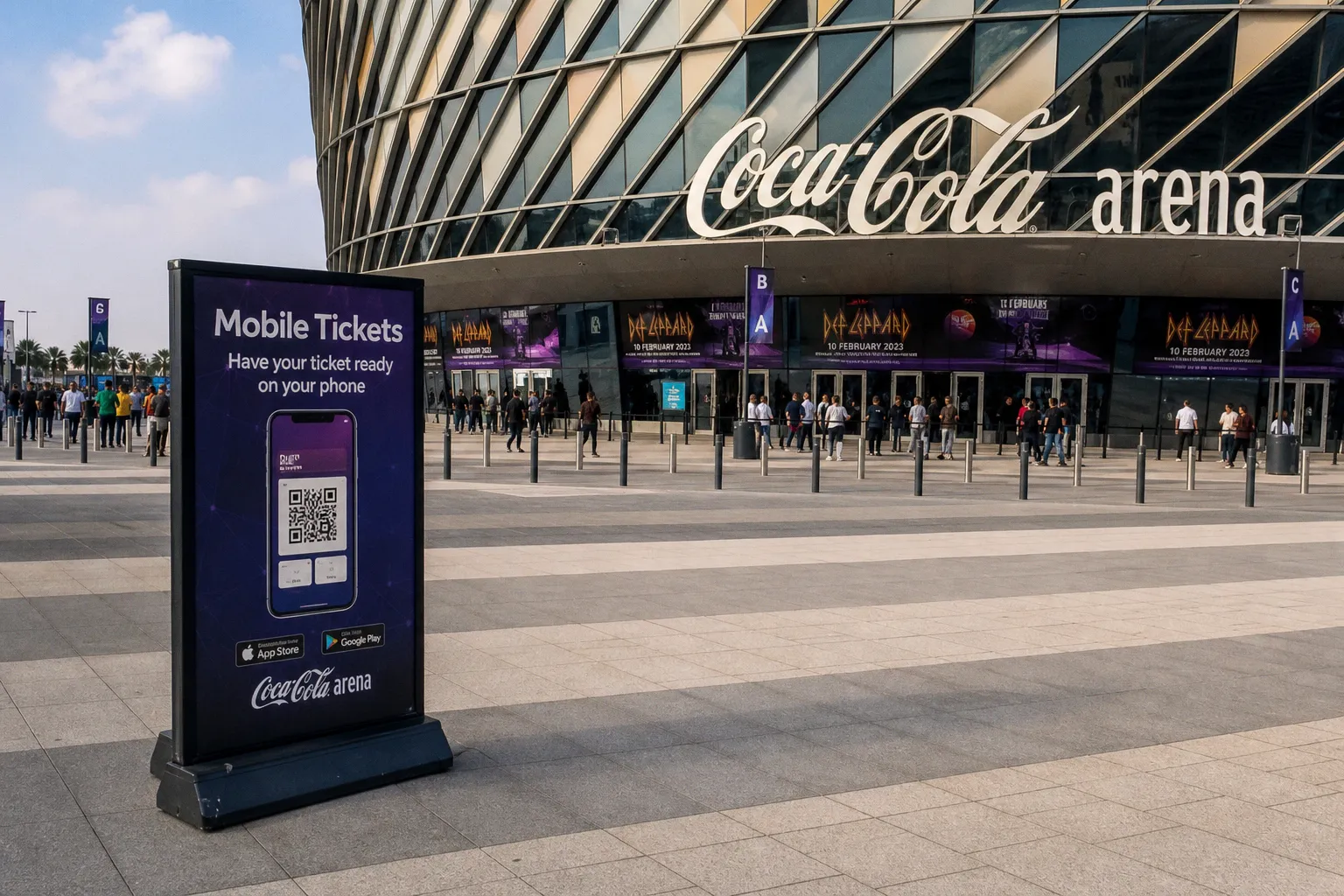
A conventional mobile ticket usually behaves like a temporary permission slip. The purchaser receives a barcode or QR code; the platform retains the authoritative record; after the gates close, the ticket becomes an email attachment with little cultural residue. The customer may remember the night, but the system has produced no object worth keeping.
An NFT ticket can be designed differently. It can be admission first, but also a digital collectible pass, a membership key, a record of attendance, or a controlled access layer for future drops. The tangible utility is not the blockchain in isolation. It is the ability to give an event credential a life beyond the scanner.
For a festival with a strong identity, that is a meaningful design choice. VIP access is already status signaling. It is a visible hierarchy of queues, terraces, artist areas, and hospitality. Tokenizing it does not invent prestige; it gives that prestige a persistent, programmable container.
The useful NFT ticket is not a speculative ornament. It is a better-shaped credential.
That distinction is why EXIT’s choice matters. It was not necessarily an argument that every general-admission ticket should become an Ethereum asset. It was an argument that the high-value ticket—the one with social meaning, repeat utility, and an audience willing to retain it—does not have to die at the gate.
What changes when the ticket is ERC-721 rather than a database row
The technical elegance of smart contract ticketing is often overstated, but its basic anatomy is genuinely useful.
Under the ERC-721 standard, a token is identified by the combination of a smart-contract address and a token ID. That pair provides a globally unique identifier for a particular asset on an Ethereum chain. The contract can expose ownership information and transfer functions. In practical ticketing terms, this means a festival can create a recognizable class of credential whose ownership history is legible within that system.
A legacy SaaS platform can also maintain a perfectly good ticket database. In fact, most do. The difference is not that one system stores data and the other somehow does not. The difference is where authority sits, what can travel outside the original vendor interface, and whether the ticket is designed as a reusable product rather than a closed booking record.
Here is the comparison I would make when handling a VIP ticket product, rather than a mass-market seat assignment.
| Product question | Conventional SaaS ticket | NFT-based ticket |
|---|---|---|
| Source of truth | Ticket issuer’s central database | Smart contract plus the organiser’s operational systems |
| Ownership transfer | Usually managed within the platform’s resale rules | Can be transferred on-chain, subject to the contract and marketplace design |
| Post-event life | Often expires into an archived receipt | Can remain a collectible, membership key, or loyalty credential |
| Visual identity | Typically a functional barcode in an app | Can be art-directed as a branded digital collectible pass |
| Gate validation | Scanner checks a barcode or account credential | Scanner must authenticate current ownership or a valid access proof |
| Resale policy | Defined by platform terms and marketplace controls | Must be deliberately encoded and enforced by the relevant interfaces |
| Customer experience risk | Familiar login and support workflows | Wallet recovery, onboarding, custody, and support can become friction points |
The final row is the one too many NFT ticketing decks decorate away. A token that is technically pristine but impossible for a festival-goer to retrieve is not premium. It is merely brittle.
For online event ticketing, the aesthetic test and the operational test are inseparable. If I need a specialist wallet, a seed phrase, a gas-fee explanation, and a patient friend before I can enter a concert, the product has confused infrastructure with hospitality. Good NFT event access should feel closer to a polished airline boarding pass or a hotel key in a native app: the cryptographic rails are doing their work, but they do not demand applause.
The gate remains stubbornly physical. Someone must present something. A device must validate it. A staff member must resolve the awkward cases: poor connectivity, a dead phone, a transferred ticket that has not refreshed, an attendee who bought through an authorised channel but cannot explain their wallet setup. The most sophisticated smart contract cannot wave a guest through a metal barrier by itself.
That is why the best tokenized ticket designs should retain a dual sensibility:
- The token should be unique and verifiable, with an ownership model that can be checked against the issuer’s rules.
- The access experience should be familiar, ideally through account abstraction, email-based onboarding, or a branded pass interface rather than a wallet tutorial.
- The physical journey should be choreographed, from purchase confirmation to gate recovery desk, with the same care given to wristbands and VIP lanyards.
- The visual asset should earn retention, because an ugly, generic token screen will not become a meaningful digital souvenir simply because it sits on-chain.
The token’s value is not that it replaces every database. Its value is that it can make a ticket more than a database entry.
Fraud, bots, and fees: what blockchain can actually repair
Ticketing has a recurring habit of promising clean solutions to dirty market problems. NFTs are not exempt.
A uniquely identifiable token can support stronger ownership verification than a screenshot-able QR code. But it does not make fraud impossible. Fraud prevention still depends on secure issuance, authenticated gate validation, wallet or account security, clear transfer policies, and a capable operations team. A stolen account can still be a stolen account. A phishing page can still persuade a guest to surrender access. A poorly designed scanner workflow can still create a queue full of people with valid credentials and no way to prove it quickly.
Bots and scalping require the same sobriety. In the United States, the Better Online Ticket Sales Act prohibits circumventing an issuer’s security, access-control, or technological measures for public events held at venues with capacity above 200. That law exists because ticket access is not merely a software question; it is a contest between issuers, automated buyers, resellers, and fans.
Blockchain does not automatically end that contest. It can give an issuer more programmable tools, but only if those tools are actually implemented at the sale and resale layers.
The fees question is equally revealing. The U.S. Federal Trade Commission’s rule on unfair or deceptive fees took effect on May 12, 2025. It requires total prices and mandatory fees for live-event tickets to be disclosed upfront, including in secondary markets. It does not tell organisers what they may charge; it insists that the price be visible before the buyer is deep inside the funnel.
That is not a blockchain rule. It is a product-decency rule.
In a non-generalizable sample reviewed by the U.S. Government Accountability Office, primary-market ticketing companies charged average total fees of 27% of ticket price, while secondary-market companies averaged 31%. Some white-label resale sites charged more than 40%. Those figures should not be pasted across every market as universal truth, but they make one thing painfully plain: ticket buyers are often asked to accept a price architecture designed to reveal itself late.
An NFT ticket can make transfers and transaction history more legible. It cannot make an opaque commercial model respectable by itself. Nor does a smart contract eliminate fee extraction; a marketplace may still charge fees, and blockchain networks have their own transaction costs and interface costs.
There is a strange parallel here with the wider market’s appetite for automated digital systems. AI-driven trading infrastructure is reshaping how assets move and decisions are executed, but automation only changes the surface of the market if its incentives remain untouched. Ticketing is no different. Faster rails are not fairer rails unless the organiser designs fairness into the product.
Transparency is not a feature you bolt onto ticketing. It is the basic lighting in the room.
The resale problem is a design problem, not a royalty setting
The most seductive NFT ticketing fantasy is the “perfect resale market”: fans can resell safely, organisers retain control, prices remain sane, and every trade returns value to the event. In reality, each part requires a separate decision.
ERC-2981 standardizes a way for an NFT contract to report royalty recipient and royalty amount information. That is useful metadata. It does not force every marketplace to pay royalties on every resale. Transfers can happen without a sale, and royalty payment depends on the marketplace or participants honoring the standard’s information.
This is more than a technical footnote. It is the gap between a designer’s sketch and the finished garment.
If an organiser wants authorized resale, it needs to decide where the ticket can be transferred, whether the buyer must use an approved marketplace, whether price caps exist, whether transfers pause near showtime, how refunds work, and what happens when a guest’s identity matters. A royalty percentage does not answer any of that.
ERC-7439, created in July 2023, points toward a more specific ticketing use case: an ERC-721 extension proposed for authorized resale and anti-touting controls. It is an intriguing direction, not a magic seal of adoption. Its existence does not prove that a particular festival or marketplace has implemented it, and it does not relieve an event organiser of building the customer-facing rules around it.
For a real festival pass, I would judge resale architecture by four questions:
1. Can the issuer define legitimate transfer routes?
If the ticket can wander anywhere with no distinction between a gift, a resale, and a suspicious transfer, the organiser has traded control for novelty.
2. Can the buyer understand the final price?
A resale interface that hides mandatory charges until the final click has simply recreated the worst SaaS habits in a different visual language.
3. Can access privileges be separated from pure collectibility?
A VIP token may include entry, lounge access, merchandise entitlement, or future membership. Those benefits may need different transfer rules. Treating them as one indivisible blob is lazy product design.
4. Can the festival handle exceptions humanely?
Name changes, travel disruption, device loss, accessibility requirements, and legitimate gifting are not edge cases in live events. They are the job.
The compelling version of blockchain ticket utility is not unrestricted circulation. It is selective permeability: a ticket can move when it should, retain its provenance when that matters, and refuse the kinds of transfer that undermine the event’s relationship with its audience.
That is a far more sophisticated ambition than promising that “resale is on-chain.”
The collectible after the crowd leaves
The most culturally persuasive part of tokenized event access begins after admission has ended.
POAP—Proof of Attendance Protocol—frames its collectibles as NFTs that record participation in a physical, virtual, or spiritual event. A POAP can also qualify its holder for future utility. That makes it particularly suited to an overlooked part of festival culture: the need to turn a transient gathering into a durable identity signal.
But there is a necessary distinction. A POAP is primarily a proof-of-attendance collectible; it should not be casually presented as proof of legal admission. The ticket gets the guest through the gate. The attendance token says, in effect, “I was there.” Those are related functions, but they are not interchangeable.
For brands and festivals, this separation is liberating.
A ticket needs practical rigor. It may involve seat category, age restrictions, transfer conditions, refund rules, and entry validation. A post-event collectible can be more expressive. It can carry stage-specific artwork, evolve after an artist set, unlock early access to next year’s presale, or serve as a quiet membership marker for people who return.
This is where physical-to-digital design becomes more than a technical stack. A well-made wristband has tactile authority: it frays, photographs well, accumulates memory. A great digital collectible pass needs the same emotional engineering. It should feel authored, specific, and scarce in the cultural sense—not artificially deprived, but connected to an experience that cannot be repeated.
For EXIT, a VIP NFT pass had the potential to operate in both registers. Before the festival, it could function as access. During the festival, it could become a visible badge within the guest ecosystem. After the festival, it could remain a trace of attendance and perhaps a future utility key. That is a fuller product lifecycle than the standard ticket PDF can offer.
The risk is that organisers mistake permanence for meaning. Not every attendee wants an on-chain artifact. Not every event has enough visual language or community density to justify one. A generic corporate conference token is unlikely to gain cultural cachet simply because it has a contract address. The object needs a reason to be kept.
EXIT’s decision has longevity—but only as a premium model
I do not read EXIT Festival’s 2022 move as proof that SaaS ticketing is obsolete. SaaS remains extraordinarily good at broad distribution, customer support, payment routing, familiar account flows, and the unglamorous operational work that keeps large events alive.
I read it as a sharper proposition: some tickets deserve to be treated as products with provenance, identity, and afterlife.
The case is strongest for VIP access, limited festival editions, season passes, artist fan-club entry, and events whose audiences already understand belonging as part of the purchase. In those categories, blockchain-based ticketing can add tangible utility rather than decorative complexity. It can turn admission into a branded object with a memory layer.
EXIT’s announcement did not publicly prove lower fraud, lower fees, shorter queues, or a total departure from conventional systems. Those are outcomes that need evidence, not atmosphere. Yet the experiment remains instructive because it identified the right pressure point: the ticket is not merely a receipt for access. At its best, it is the first physical-digital artifact an event places in a guest’s hand.
Or, increasingly, in their phone.
The durable market will not belong to the festivals that tokenize every barcode. It will belong to the ones that understand which moments deserve a credential with a second life—and build the gate, the resale rules, the design language, and the human support around that idea.