Counterfeit Breitlings and the Blockchain Hammer
Since October 2020, Breitling has issued a unique digital passport with every watch leaving its factory. The passport is not a marketing gimmick. It is not speculative NFT art. It is a functional utility token that proves ownership, records service history, and transfers with the watch when it changes hands on the secondary market.
For buyers navigating pre-owned Breitlings—whether through dealers, auction houses, or private sales—the digital passport has become the single most reliable authentication signal. The verification process takes ninety seconds. The consequences of skipping it can last a lifetime.
The Breitling digital passport is not collectible art. It is a certificate of authenticity that lives on-chain and moves with the watch.
The Digital Twin: NFC, Warranty Card, Arianee Protocol
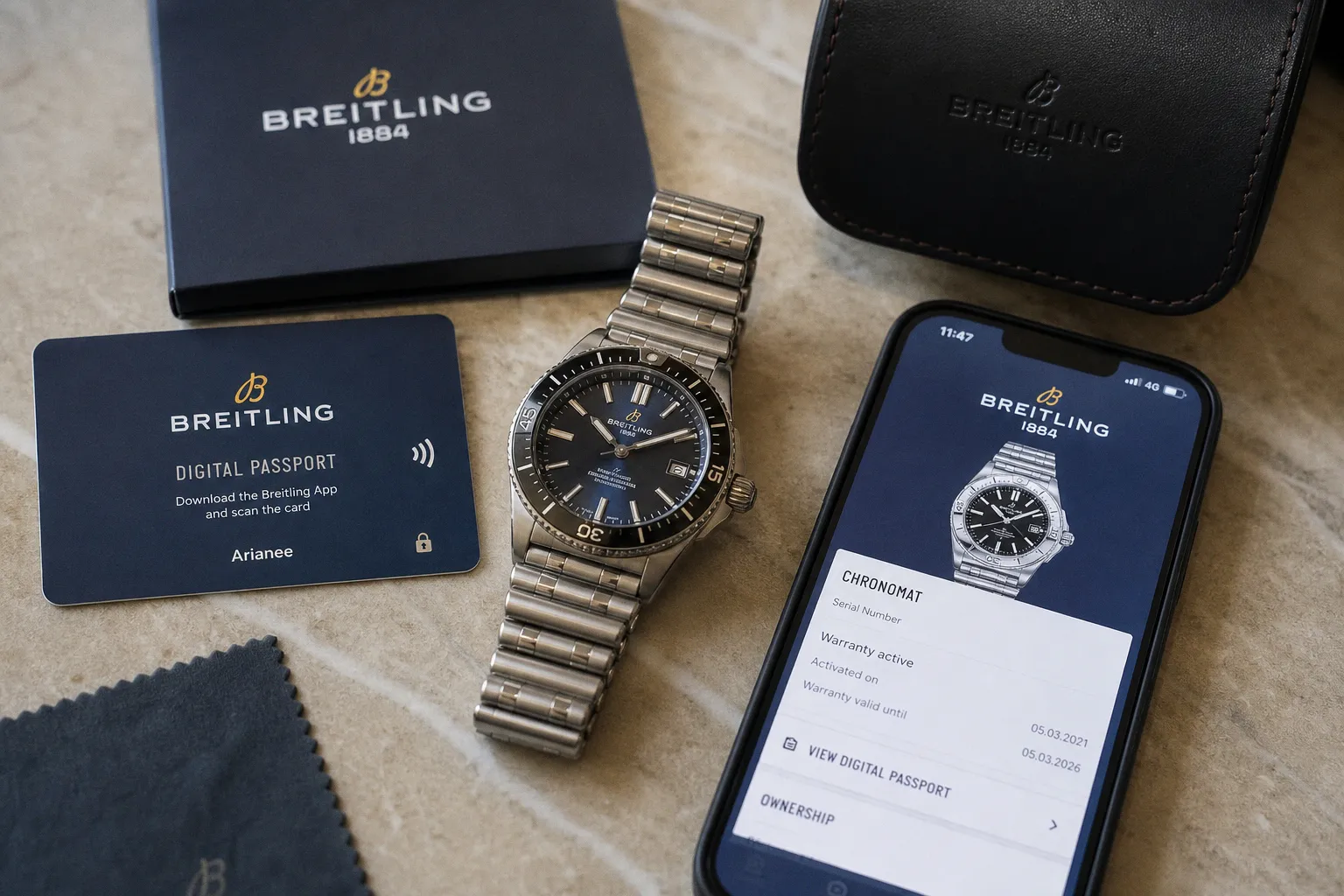
Breitling's authentication architecture rests on three components: an NFC chip embedded in a physical warranty card, the Breitling mobile application, and the Arianee blockchain protocol.
The NFC chip lives inside the warranty card that ships with every new Breitling since 2020. It contains a unique identifier linked to the watch's serial number. The buyer taps the card against a smartphone running the Breitling app. The app reads the chip, queries the Arianee blockchain, and pulls the associated digital passport onto the screen.
Arianee is an open-source blockchain purpose-built for digital product passports. Breitling selected Arianee for its focus on luxury authentication, low transaction costs, and commitment to data privacy. The protocol records every meaningful interaction—initial issuance, authorized service, ownership transfer—on an immutable public ledger.
The digital passport itself contains structured data: serial number, model reference, production date, warranty status, service history, and current ownership. None of this data lives on Breitling's internal servers. It lives on the blockchain, accessible to anyone holding the physical warranty card and the tools to read it.
This architecture eliminates a critical vulnerability in traditional authentication: dependence on centralized databases that can be hacked, altered, or simply discontinued. The blockchain does not forget.
Step-by-Step: Scanning the NFC Warranty Card
The verification sequence for a pre-owned Breitling follows a strict order. Skipping steps creates exposure.
Step 1: Demand the Warranty Card
Request the physical warranty card from the seller before meeting or releasing funds. The card is not a bonus—it is the physical anchor of the digital passport. A seller who cannot produce it, or who claims the watch predates the passport system without supporting documentation, is signaling risk.
Pre-2020 Breitlings may not carry digital passports. Some have been retrofitted through authorized service centers, but buyers of vintage pieces should verify the absence of a passport is consistent with the production date.
Step 2: Scan the NFC Chip
Download the Breitling app to an NFC-capable smartphone. Hold the warranty card against the back of the phone. The chip activates. The app retrieves the digital passport from the Arianee blockchain.
If the scan fails:
- The NFC chip may be damaged or tampered with.
- The card may be a replica without a functional chip.
- The watch may not have a registered passport on the chain.
Any of these outcomes means the transaction should pause.
Step 3: Verify the Data
Once the passport loads, the buyer confirms:
- Serial number match between the engraved case number and the registered passport.
- Model reference consistency with the physical watch.
- Ownership history showing transfers from Breitling to each subsequent holder.
- Service records logged by authorized Breitling service centers.
- Warranty status with clear active or expired dates.
Inconsistencies between physical and digital data are deal-breakers. Walk away.
Step 4: Confirm Transfer Eligibility
If verification passes, confirm that the seller will initiate the digital ownership transfer. The warranty card is necessary but not sufficient. The passport must transfer through the Breitling app or the Arianee wallet interface to the buyer's account.
A seller who hands over the card but refuses to transfer the passport is handing over half the asset. The buyer inherits a watch whose digital identity remains registered to someone else.
If the NFC scan doesn't pull a passport, you are not buying a Breitling with a digital identity. You are buying a heavy object with a story.
Provenance, Service History, and the Arianee Ledger
Arianee's protocol design aligns precisely with luxury authentication requirements.
Immutability sits at the core. Service records and ownership transfers, once logged, cannot be edited or deleted. The provenance trail is permanent. A seller cannot scrub service history to hide damage or undocumented repairs.
Privacy is enforced through encryption. Personal data on the passport is protected. Ownership transfers record wallet addresses, not buyer identities. The public ledger shows transactions; it does not expose individuals.
Interoperability positions Arianee as a potential cross-brand standard. The protocol operates as an open framework that other luxury manufacturers can adopt. Breitling's early bet gives it a first-mover advantage in a standard that could eventually span the Swiss watch industry.
Cost efficiency matters at scale. Arianee handles identity transactions at minimal cost, unlike congested mainnet chains where a single transaction can cost more than a service interval at an authorized dealer. For a brand issuing passports to hundreds of thousands of watches annually, predictable low-cost infrastructure is non-negotiable.
Breitling's commitment to Arianee predates the NFT hype cycle. The brand began issuing digital passports in 2020, before "phygital" became a marketing buzzword and before most luxury houses had explored blockchain authentication at all. That early move positions Breitling years ahead of competitors still debating whether to tokenize their warranties.
Secondary Market Transfers: The Digital Handshake
The secondary market is where the digital passport proves its full value—or exposes its absence.
The Transfer Process
When a Breitling changes hands, two transfers must occur simultaneously: the physical handover of the watch and warranty card, and the digital transfer of the passport through the Arianee protocol.
The current owner initiates the transfer via the Breitling app. The recipient receives a transfer request, accepts it, and the blockchain logs the new ownership. Both parties receive confirmation.
The process is designed for frictionless execution. In practice, it requires both parties to engage with the digital system—a hurdle for traditional watch buyers and sellers unfamiliar with blockchain wallets.
Why the Dual Transfer Matters
Authorized Breitling service centers reference the digital passport to verify legitimacy. If the passport shows a previous owner as the registered holder, the service center may flag the watch for additional authentication. Warranty claims stall. Future resale becomes harder.
Buyers who acquire a Breitling without completing the digital transfer inherit a provenance gap. The watch functions. Its on-chain identity is broken.
Red Flags on Resale
- Seller provides a warranty card but no NFC response when scanned.
- Passport loads but serial number does not match the physical watch.
- Seller claims pre-2020 production but the model and date suggest otherwise.
- Seller refuses to initiate digital transfer.
- Service history is absent from a watch claimed to have multiple service intervals.
Each red flag demands further investigation or outright rejection.
Utility Tokens vs. Speculative NFT Hype
Breitling's digital passport occupies a specific category: functional utility tokens tied to physical goods. It shares almost nothing with the speculative NFT market that dominated headlines in 2021 and 2022.
The passport generates no yield. It carries no speculative premium. It does not grant access to metaverse experiences, token-gated communities, or exclusive digital art drops. Its value is direct and tangible: it authenticates a physical object worth thousands of dollars.
This distinction matters for collectors and investors evaluating the broader phygital NFT landscape. The market has matured beyond profile-picture projects into utility-driven applications. Breitling's implementation is a case study in how brands deploy blockchain for authentication rather than speculation.
| Parameter | Breitling Digital Passport | Speculative NFT Collectible |
|---|---|---|
| Primary function | Authentication and provenance | Speculation and community access |
| Yield generation | None | Variable (staking, royalties) |
| Tied to physical asset | Yes (watch + NFC warranty card) | No |
| Transfer mechanism | NFC scan plus blockchain confirmation | Wallet-to-wallet transfer |
| Value driver | Watch condition, brand equity | Floor price, rarity tier |
| Service integration | Authorized service centers log to chain | None |
The infrastructure supporting these utility applications continues to mature. When a watchmaker trusts a blockchain with proof of ownership for a $50,000 timepiece, the underlying infrastructure must meet enterprise-grade reliability. That reliability is no longer theoretical—it is measured in millions of authenticated transactions across luxury, pharmaceutical, and automotive supply chains where product passports now operate at industrial scale.
The convergence of luxury authentication and maturing blockchain infrastructure signals where the phygital market is heading: toward systems where a digital passport is as expected as a signed receipt, and where its absence is itself a red flag.
The Verification Protocol
The verification process is not complex. It is, however, non-negotiable for anyone spending serious money on a pre-owned Breitling.
Scan the card. The NFC chip in the warranty card is the entry point. No scan, no passport, no provenance.
Confirm the serial numbers. Physical and digital must match. Mismatch equals counterfeit or swapped components.
Review service history. Authorized service entries should appear for any watch claimed to have undergone maintenance.
Verify the ownership chain. The passport should show transfers from Breitling to each subsequent owner.
Complete the digital transfer. The seller initiates. The buyer accepts. Both parties confirm.
If the digital layer is intact, the physical watch carries blockchain-backed provenance that survives resale, service, and insurance claims. If the digital layer is missing, the buyer is negotiating on price—or walking away.
The Question Facing Swiss Watchmaking
The secondary market for luxury timepieces will continue to battle counterfeits. Breitling's digital passport is among the most robust authentication frameworks deployed by a major Swiss manufacturer.
Will Rolex, Omega, Patek Philippe, and Audemars Piguet follow Breitling's lead and tokenize their warranties? Or will the secondary market remain a minefield of paper certificates, dealer reputation, and hope?
The blockchain hammer is already swinging. The brands that ignore it will answer to collectors who have learned to scan before they sign.